
Alaska Range
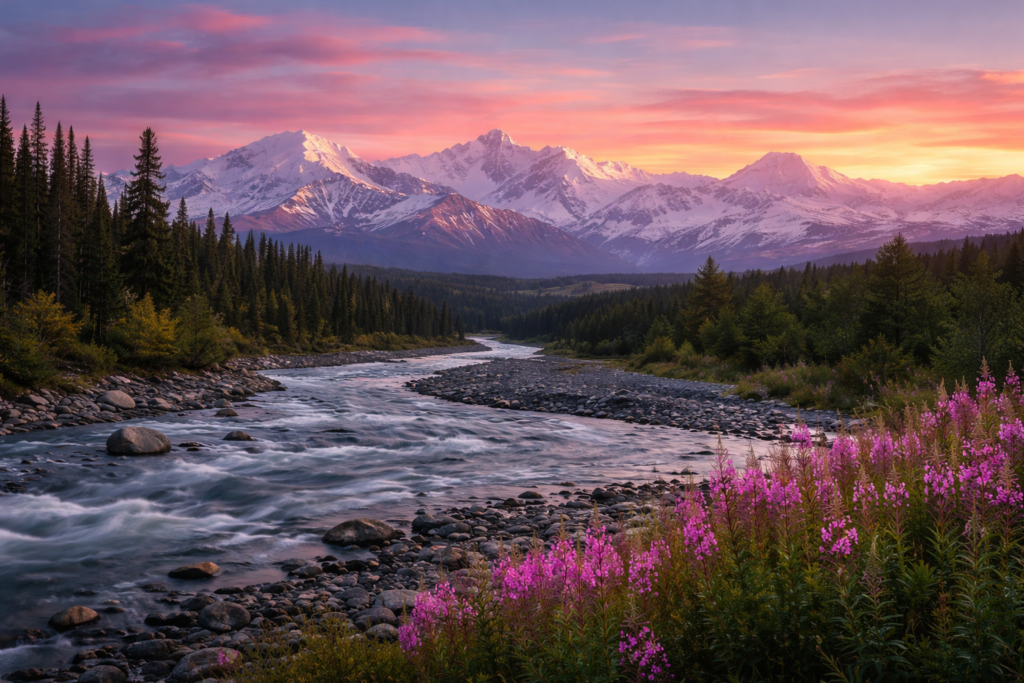
The Alaska Range stretches across southcentral Alaska and is home to some of the tallest and most well-known mountains in North America, including Denali, Mount Foraker, and Mount Hunter. It runs in an arc from the Alaska–Canada border west toward the Alaska Peninsula, forming a massive natural barrier between Interior Alaska and the southern coast.
This range is defined by height, but also by how sharply it rises. Peaks in the Alaska Range don’t just sit high — they climb quickly from lower terrain into steep, glaciated mountains. Denali alone rises over 20,000 feet, and several nearby peaks push well above 14,000 feet, creating one of the most dramatic mountain landscapes in the world.
Glaciers are a major part of what shapes the Alaska Range. Huge ice systems flow down from the mountains into surrounding valleys, feeding rivers that run through Interior Alaska. The Kahiltna Glacier, one of the largest in the range, is a primary route for climbers attempting Denali and a clear example of how massive these ice systems are. These glaciers aren’t just features — they define how the land looks, moves, and changes over time.
Most people experience the Alaska Range from Denali National Park, where the mountains stretch across the horizon and dominate the landscape on clear days. This is also the only place where the range is widely accessible without specialized travel. Outside the park, parts of the range can be seen from the Parks Highway and the Denali Highway, though visibility depends heavily on weather and cloud cover.
The range also creates its own climate divide. South of the mountains tends to be wetter and more coastal, while north of the range shifts into the drier Interior climate. Weather patterns often build along the peaks, which is why the mountains are frequently hidden behind clouds — even on otherwise clear days nearby.
Wildlife lives throughout the lower elevations and valleys, including grizzly bears, caribou, wolves, and Dall sheep. The open tundra and rolling foothills below the peaks are where most animals are actually seen, not in the high alpine zones. This contrast between the wide, open ground and the towering mountains above is part of what makes the area feel so expansive.
While most of the Alaska Range is remote and not trail-based, there are a few places where visitors can actually hike and experience it up close. In the Denali area, trails like Savage River, Horseshoe Lake, and Triple Lakes can be found on Denali’s “Where to Hike” page. South of the range near Talkeetna, local trail systems and viewpoints can be included under your Talkeetna hiking section. Along the Denali Highway near Cantwell, the terrain opens into tundra and ridgelines where informal hiking can be found on the Cantwell “Where to Hike” page.
The Alaska Range isn’t just a backdrop — it’s one of the defining features of the state. It shapes the landscape, the weather, and the way people experience Alaska, whether they’re seeing it from the road, the air, or deeper into the range itself.