
Mount Redoubt
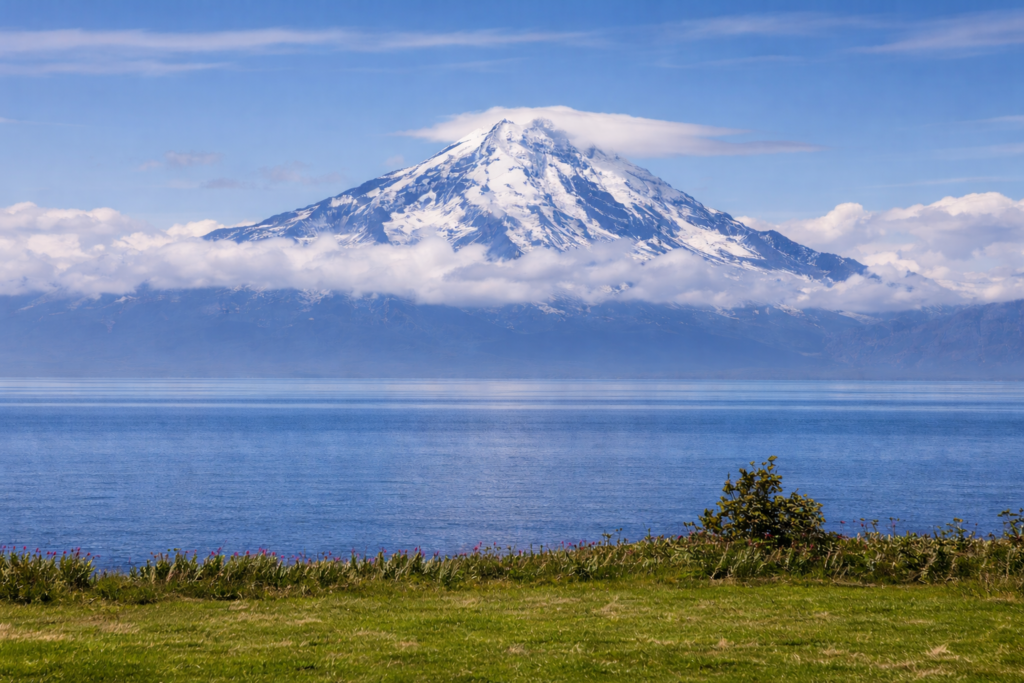
Mount Redoubt rises to 10,197 feet on the west side of Cook Inlet and is one of the most active volcanoes in Alaska. It’s part of the Aleutian volcanic arc, a chain of volcanoes that stretches across southern Alaska, formed by tectonic activity beneath the Pacific Ocean.
From Anchorage and parts of the Kenai Peninsula, Redoubt is often visible on clear days, standing across the inlet with a broad, snow-covered shape. It doesn’t have the sharp, jagged look of the Alaska Range — it’s more rounded and volcanic in form, with glaciers draped over its upper slopes.
Redoubt is known for its eruptions, with major activity recorded in 1989–1990 and again in 2009. These eruptions sent ash clouds high into the atmosphere, disrupting air travel and spreading ash across large areas of southcentral Alaska. It’s a reminder that this is not just a mountain — it’s an active and changing landscape.
Glaciers cover much of the volcano, and during eruptions, heat from below can rapidly melt ice, creating lahars — fast-moving volcanic mudflows — that travel down river valleys. This combination of ice and volcanic activity makes Redoubt especially dynamic compared to other peaks.
There’s no easy way to access Mount Redoubt directly. Most people experience it from a distance, either across Cook Inlet or from the air. On clear days, it stands out clearly on the horizon, especially when the light hits the snow and ice on its slopes.
Wildlife lives throughout the surrounding area, but the mountain itself feels more defined by geology than anything else — ash, ice, and heat shaping it over time. Mount Redoubt stands out because it’s active. It’s not just part of the landscape — it’s still building, still changing, and still capable of reminding people how powerful Alaska’s volcanic systems really are.