
Great Sitkin Volcano
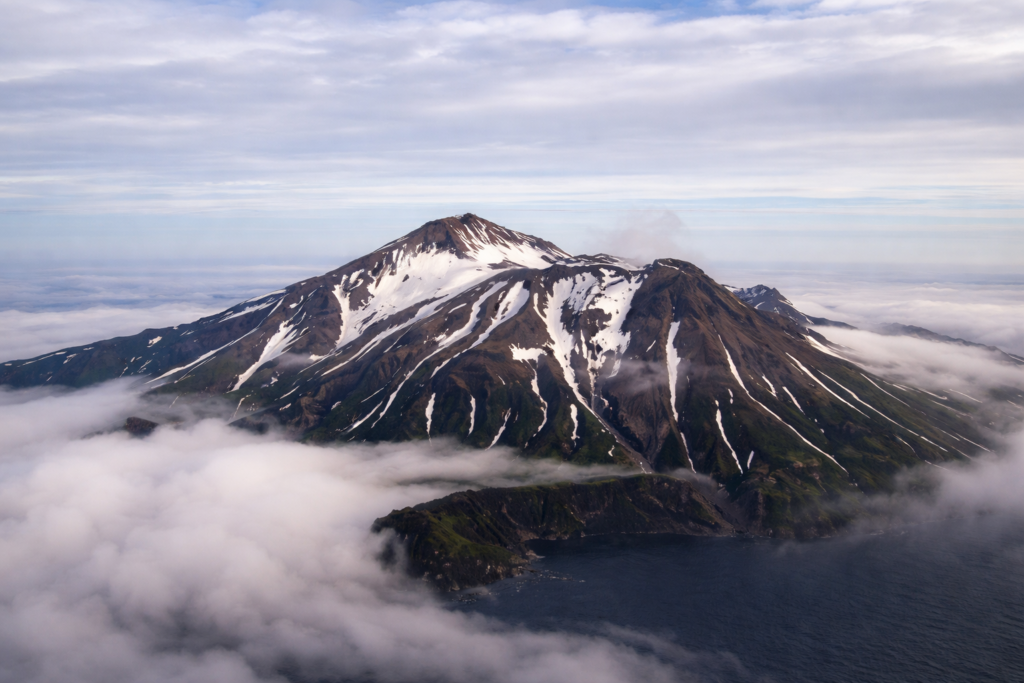
Great Sitkin Volcano rises to about 5,709 feet on Great Sitkin Island in the central Aleutian Islands and is part of the Alaska Volcano Arc. It’s not one of the tallest volcanoes in the state, but it’s one of the more active in recent years and sits in a remote stretch of Alaska where volcanic activity is a regular part of the landscape.
The volcano has a broad structure with a summit crater and a lava dome that has been growing and changing during ongoing activity. Unlike the sharp, symmetrical cones like Shishaldin, Great Sitkin looks more broken and uneven, shaped by past eruptions, collapses, and lava flows.
Recent eruptions have involved slow-moving lava building up in the crater rather than explosive events. This kind of activity doesn’t always send large ash clouds into the air, but it steadily reshapes the summit over time as new lava pushes outward and hardens.
The island itself is remote and uninhabited, so most people never see Great Sitkin up close. It’s typically observed by satellite, aircraft, or research teams, and activity is closely monitored because of its potential impact on air routes across the Aleutians.
The surrounding landscape is rugged and coastal, with steep terrain dropping toward the ocean and weather that changes quickly. Like much of the Aleutian chain, it feels isolated and constantly shaped by natural forces.
Great Sitkin isn’t dramatic in height or appearance compared to some of Alaska’s larger volcanoes, but it stands out because it’s active right now. It’s a reminder that the Alaska Volcano Arc isn’t just a past event — it’s ongoing, and places like this are still evolving in real time.