
Alaska Volcano Arc
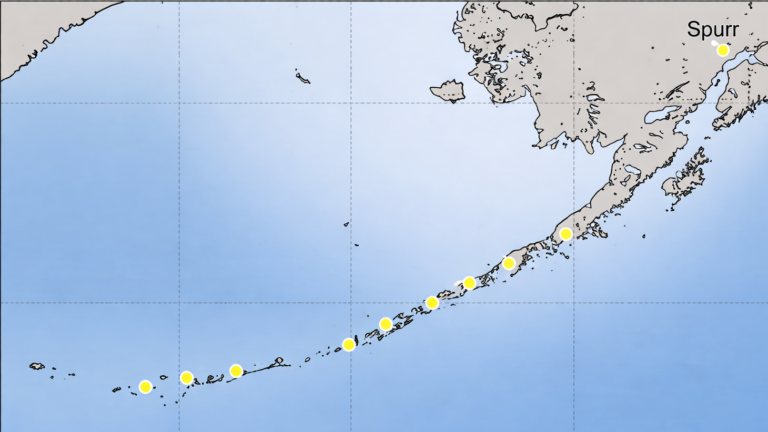
The Alaska Volcano Arc is a long chain of active and dormant volcanoes that stretches across southern Alaska and out through the Aleutian Islands. It runs for more than 1,500 miles, starting near mainland Alaska and continuing all the way toward Russia, forming one of the most active volcanic regions in the world.
This entire system exists because of tectonic movement beneath the Earth’s surface. The Pacific Plate is slowly sliding beneath the North American Plate, and as it sinks, it generates magma that rises up and forms volcanoes along the arc. That’s why so many of Alaska’s volcanoes line up in a clear chain instead of being scattered randomly.
The arc includes well-known volcanoes like Mount Redoubt, Mount Spurr, Mount Iliamna, Augustine Volcano, and Pavlof, along with dozens of others spread across remote parts of the state. Some are massive and ice-covered, while others are sharp, cone-shaped peaks that erupt more frequently.
One of the defining features of the Alaska Volcano Arc is how active it is. Eruptions happen regularly, often sending ash clouds high into the atmosphere that can disrupt air travel across Alaska and even beyond. Because of this, the region is closely monitored by scientists and the Alaska Volcano Observatory.
Many of these volcanoes are covered in glaciers, which adds another layer to how they behave. When eruptions happen, heat can rapidly melt ice and snow, creating mudflows and flooding in surrounding areas. It’s a combination of fire and ice that makes this region especially dynamic.
Most of the arc is remote and not easily accessible, especially as it extends into the Aleutian Islands. People usually experience these volcanoes from a distance, from the air, or through specific areas like Katmai National Park.
The Alaska Volcano Arc isn’t just a group of mountains — it’s an active system that continues to shape the landscape. It’s one of the reasons Alaska feels so raw and powerful, with forces beneath the surface still building and changing the land over time.