
False Hellebore in Alaska
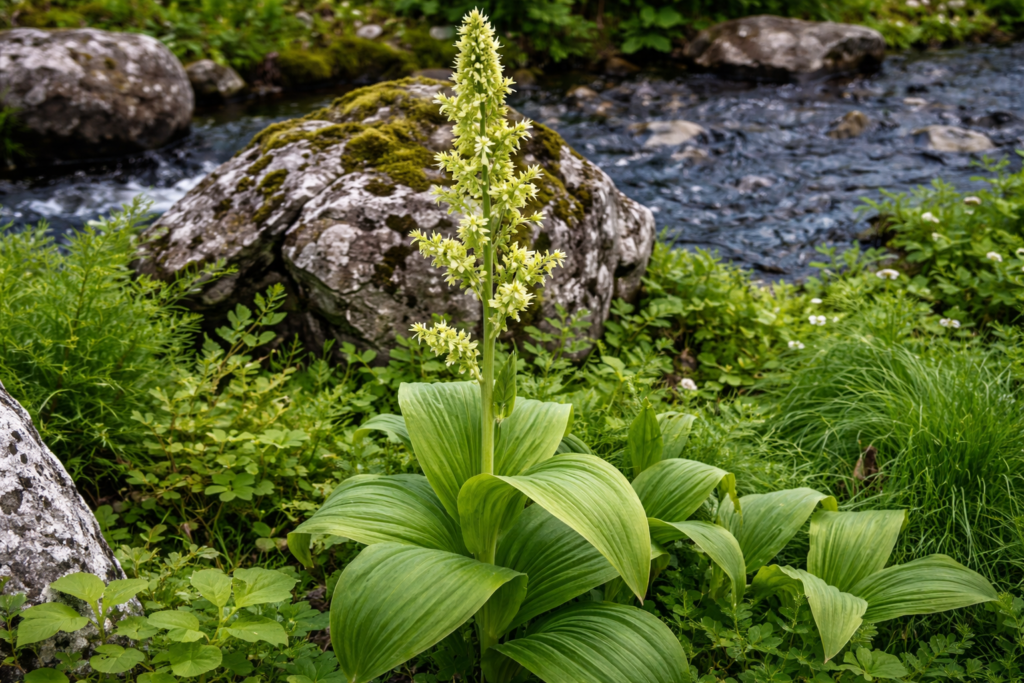
False Hellebore in Alaska
False hellebore is a large, highly toxic plant found across Alaska. With its broad, pleated leaves and tall stalk, it is one of the more noticeable plants in wet areas and is often mistaken for edible vegetation when young.
It should never be consumed.
What It Is
False hellebore (Veratrum viride) is a poisonous perennial plant that grows in moist environments.
All parts of the plant contain toxic compounds.
Where It Grows
False hellebore is commonly found in:
Southcentral Alaska
Interior Alaska
Southeast Alaska
Wet meadows
Streambanks and river edges
Marshy or saturated soils
It thrives in areas with consistent moisture and partial sunlight.
Plant Characteristics
False hellebore is a tall, leafy plant that can grow between 3 to 6 feet high.
Key features include:
Large, broad leaves with a pleated (accordion-like) texture
Leaves that wrap around the stem
Thick central stalk
Dense clusters of greenish flowers at the top
Bright green color early in the season
It often forms noticeable patches in wet ground.
Flowers & Seasonal Changes
In early summer, false hellebore produces tall flower stalks with clusters of small greenish-yellow flowers.
Earlier in the season, before flowering, the plant appears as a dense cluster of large leaves, which is when it is most likely to be misidentified.
By late summer, it becomes taller and more distinct.
Toxicity & Danger
False hellebore is highly toxic and should never be eaten.
All parts of the plant contain toxic alkaloids that affect the nervous system.
Symptoms of poisoning include:
Nausea and vomiting
Dizziness
Slowed heart rate
Low blood pressure
Confusion and weakness
Severe cases can be life-threatening.
Why It’s Dangerous
False hellebore is especially dangerous because:
It resembles edible plants when young
It grows in areas where people forage
Even small amounts can cause serious illness
Handling the plant can sometimes cause irritation
Misidentification is the primary risk.
Historical Notes
False hellebore has been historically recognized as a toxic plant and avoided as a food source.
In some cases, it was used in very controlled applications, but it is not considered safe for general use.
Identification Tips
Large pleated leaves with parallel veins
Leaves wrap around a thick central stem
Tall flower stalk with greenish clusters
Grows in wet, marshy areas
Forms dense patches
The pleated leaves are one of the easiest ways to identify it.
Why It Matters in Alaska
False hellebore is important to recognize because:
It is one of the more toxic plants found in Alaska
It can be mistaken for edible plants early in the season
It grows in common foraging areas
Proper identification helps prevent accidental poisoning
Knowing this plant is a key part of staying safe while exploring Alaska.