
Devil's Club in Alaska
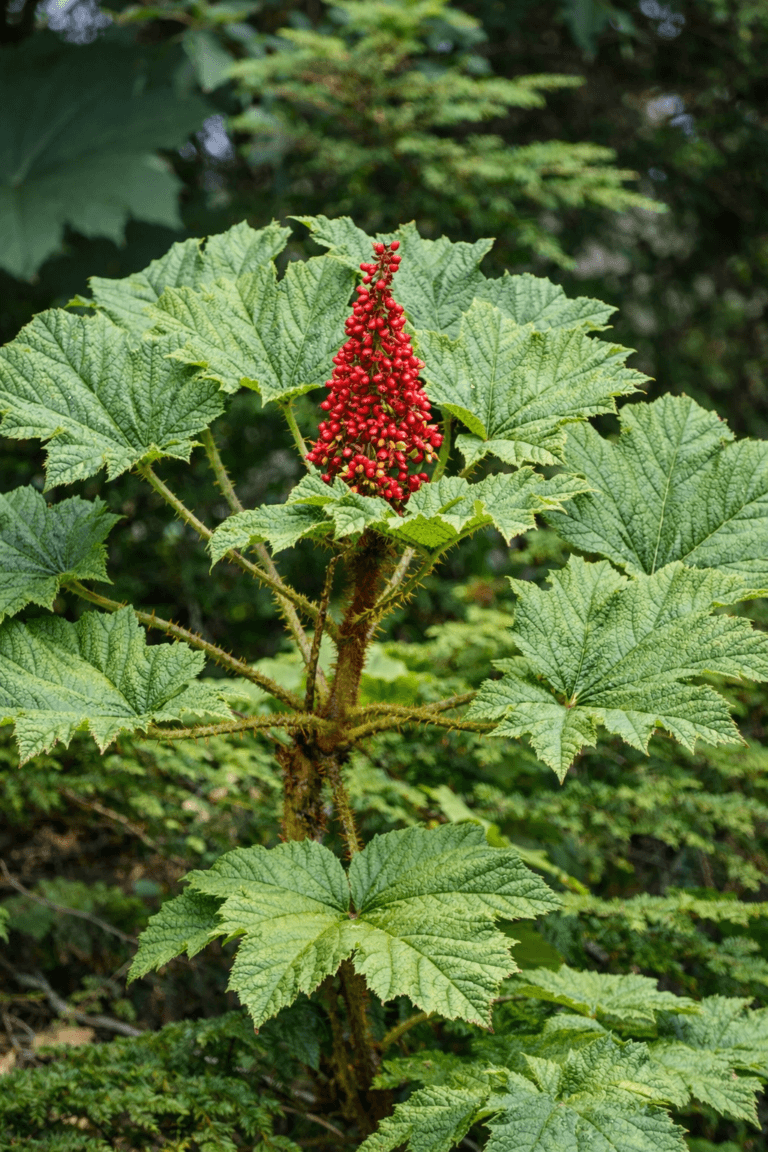
Devil’s Club in Alaska
Devil’s club is a large, spiny understory plant found primarily in Southeast and coastal Southcentral Alaska. With broad maple-like leaves and sharp spines covering its stems, it demands space and respect. It is not a plant you brush against casually. Devil’s club often marks transition zones in rainforest understory — a plant that signals you’ve entered a wetter, denser part of the forest.
Where Devil’s Club Grows
Devil’s club thrives in:
• Coastal rainforest
• Southeast Alaska
• Moist forest understory
• Streamside environments
It prefers shaded, wet conditions.
Identifying Devil’s Club
It can be identified by:
• Large palmate leaves
• Thick stems covered in sharp spines
• Clusters of red berries in late season
• Dense understory growth
The spines cover nearly the entire stem and underside of leaves.
Edible & Practical Notes
Devil’s club is not commonly used as a food plant. The berries are generally considered inedible, and the plant is better known for its traditional and herbal uses than for anything culinary.
Because of the sharp spines, thick gloves are helpful when working near the plant.
Herbal & Traditional Uses
Devil’s club is one of the most well-known and respected medicinal plants in Alaska, especially in coastal regions.
• The inner bark has traditionally been used in teas and preparations for a wide range of uses
• It has been used to support immune health and general wellness
• Preparations have also been used historically for respiratory support and as a tonic
• Some traditions include external use for skin issues or aches
Its use is deeply tied to Indigenous knowledge and cultural practices. Harvesting and preparation require care, experience, and respect for the plant.
Even today, it remains one of the most commonly referenced medicinal plants in Alaska.
Ecological Role
Devil’s club provides:
• Shelter for small animals
• Dense understory cover
• Seasonal berries for wildlife
It is part of the temperate rainforest plant community and plays a role in maintaining the structure of these dense, wet forests.
A Plant That Marks the Forest
Devil’s club is more than just a plant — it’s a signal. When you start seeing it, you know you’ve entered a different kind of landscape. Wetter, thicker, and less forgiving.
It’s one of those plants that defines the coastal forest experience in Alaska.