
Flowers of Alaska
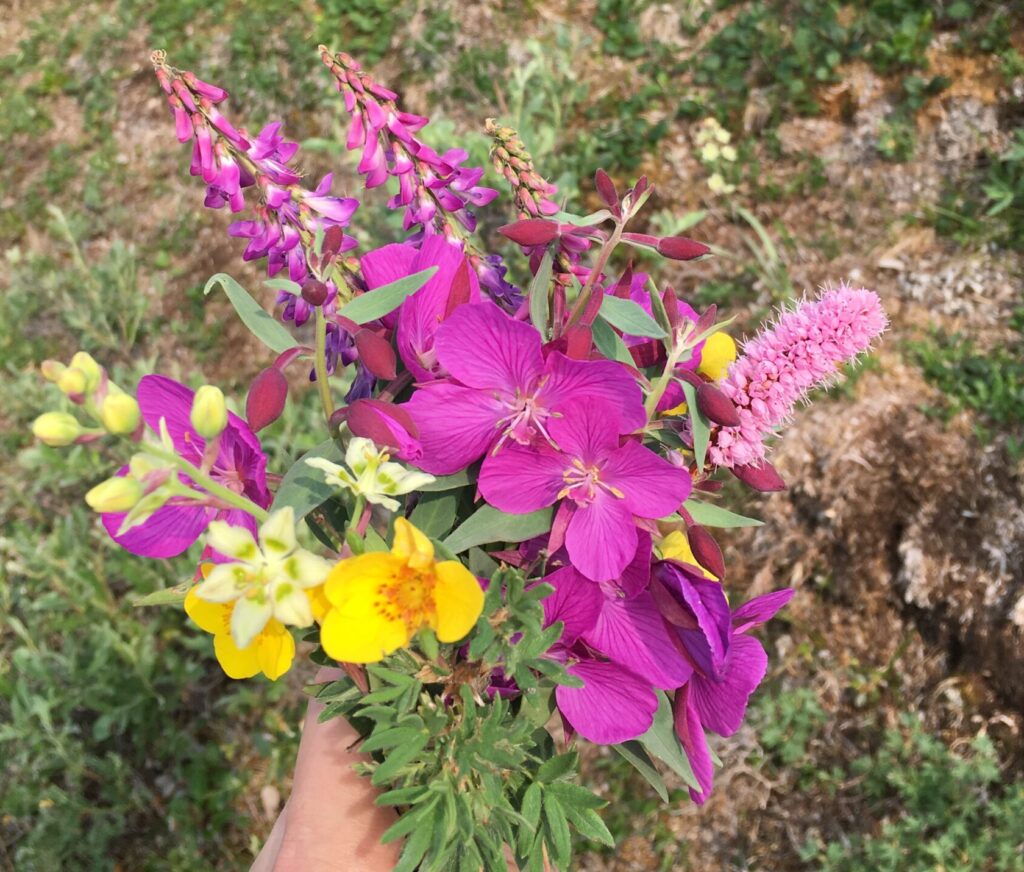
Alaska’s flowers are shaped by short summers, long winters, and a landscape that ranges from coastal rainforests to Arctic tundra. Despite the challenges of climate and growing season, wildflowers thrive across the state, bringing color and life to mountainsides, river valleys, forests, and open tundra each year.
Most of Alaska’s flowers bloom quickly, taking advantage of long daylight hours and brief periods of warmth. Many species grow low to the ground, conserve energy through the winter, and emerge as soon as conditions allow. This adaptation allows flowers to survive in environments where snow may linger well into spring and return again early in fall.
From coastal meadows and boreal forests to alpine slopes and tundra plains, flowers are an important part of Alaska’s ecosystems. They support pollinators, contribute to soil health, and play a role in subsistence, culture, and seasonal rhythms across the state.
This page provides an overview of the major types of flowers found in Alaska, where they grow, and why they matter to the landscape.
Types of Flowers Found in Alaska
Alaska’s flowers are closely tied to the environments in which they grow. Climate, elevation, soil conditions, and daylight all influence where different flowers are able to survive and bloom.
Coastal Wildflowers
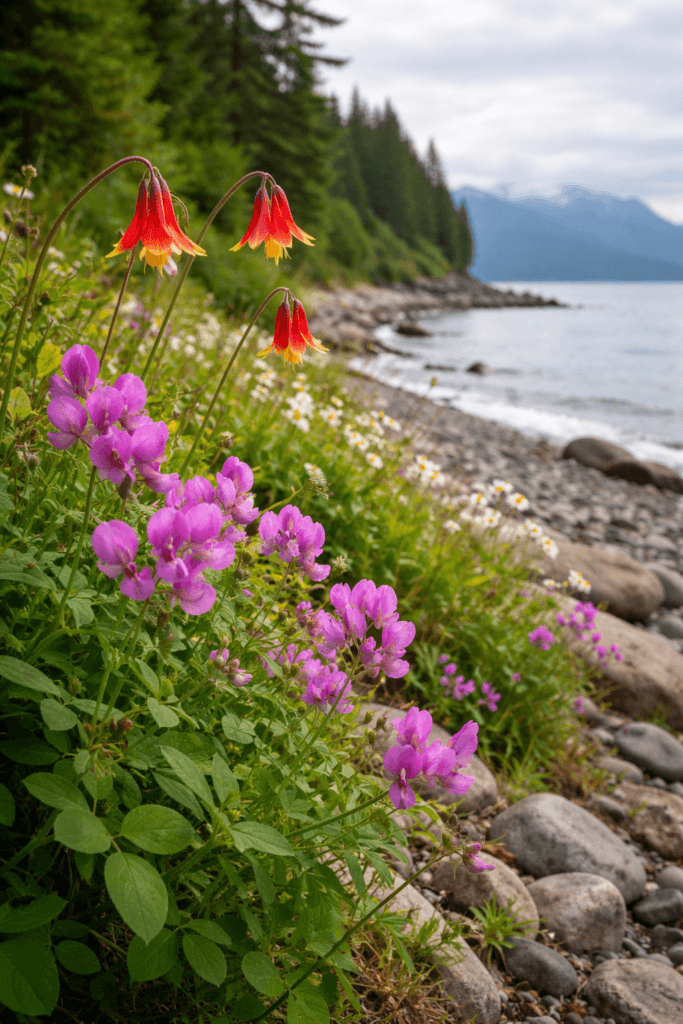
Coastal wildflowers grow in areas influenced by ocean moisture and relatively mild temperatures, particularly in Southeast and Southcentral Alaska. These flowers are often found in coastal meadows, forest edges, and open areas near shorelines.
Examples include Beach Pea, a low-growing plant commonly seen along beaches and gravel bars, and Sitka Columbine, which grows in moist coastal forests and shaded clearings.
Boreal Forest Flowers
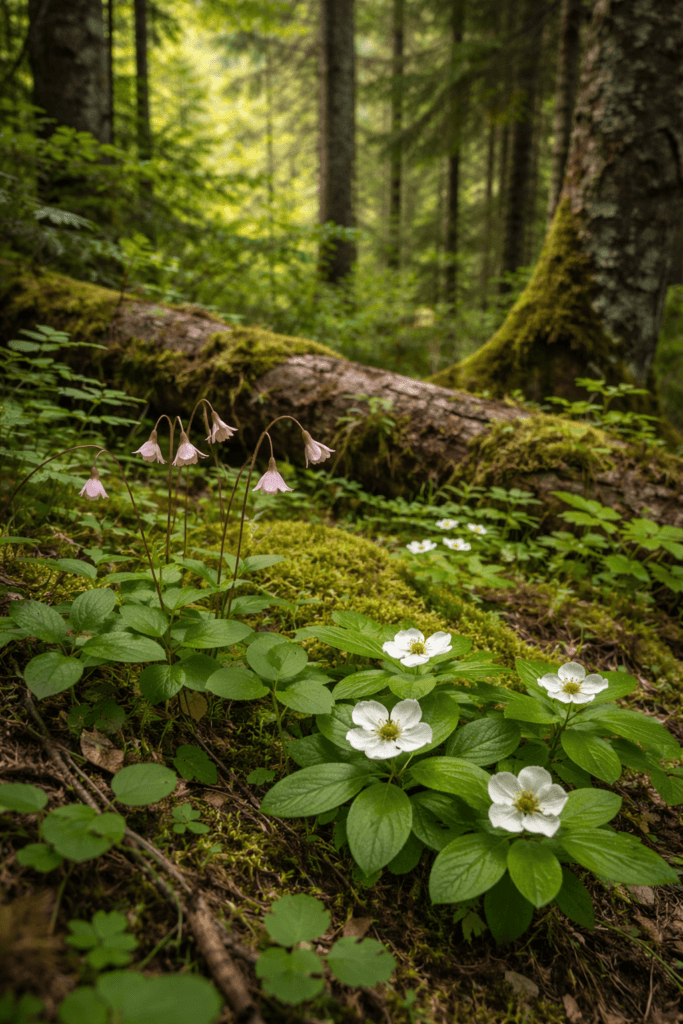
Boreal forest flowers grow beneath and along the edges of spruce and birch forests that dominate much of Interior Alaska. These plants are adapted to filtered light, cooler soils, and short bloom periods.
Common examples include Twinflower, a small trailing flower found on forest floors, and Dwarf Dogwood, which blooms early in summer along woodland edges.
Alpine Flowers
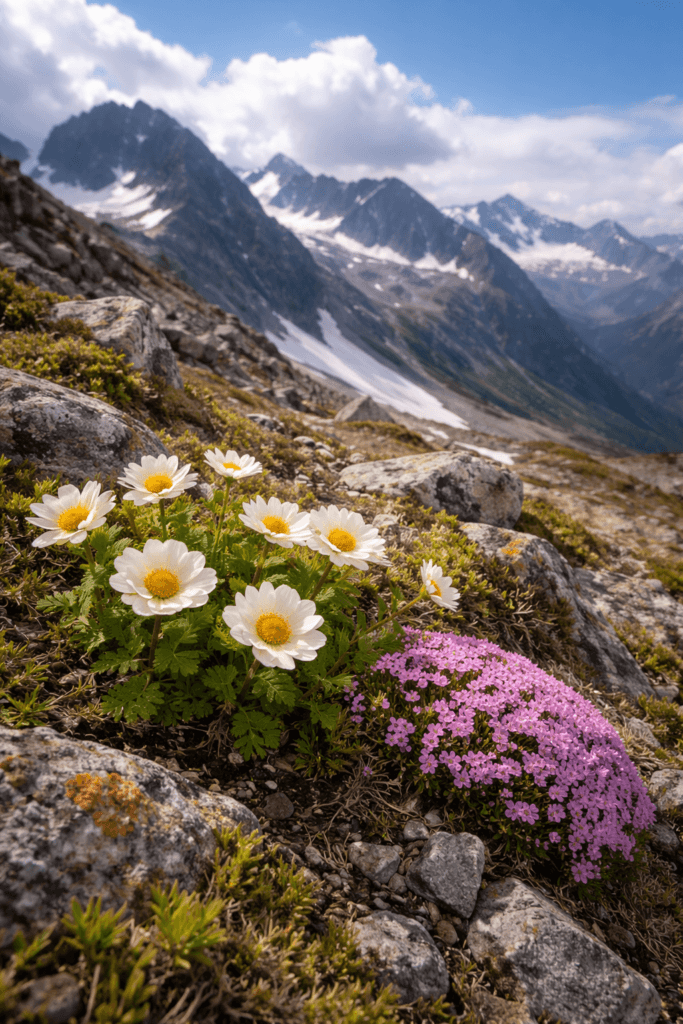
Alpine flowers grow above treeline in high-elevation environments where wind exposure is high and temperatures remain cool even in summer. These plants tend to grow low to the ground to conserve heat and withstand harsh conditions.
Examples include Mountain Avens, often found on rocky alpine slopes, and Moss Campion, which forms dense cushion-like mats in exposed areas.
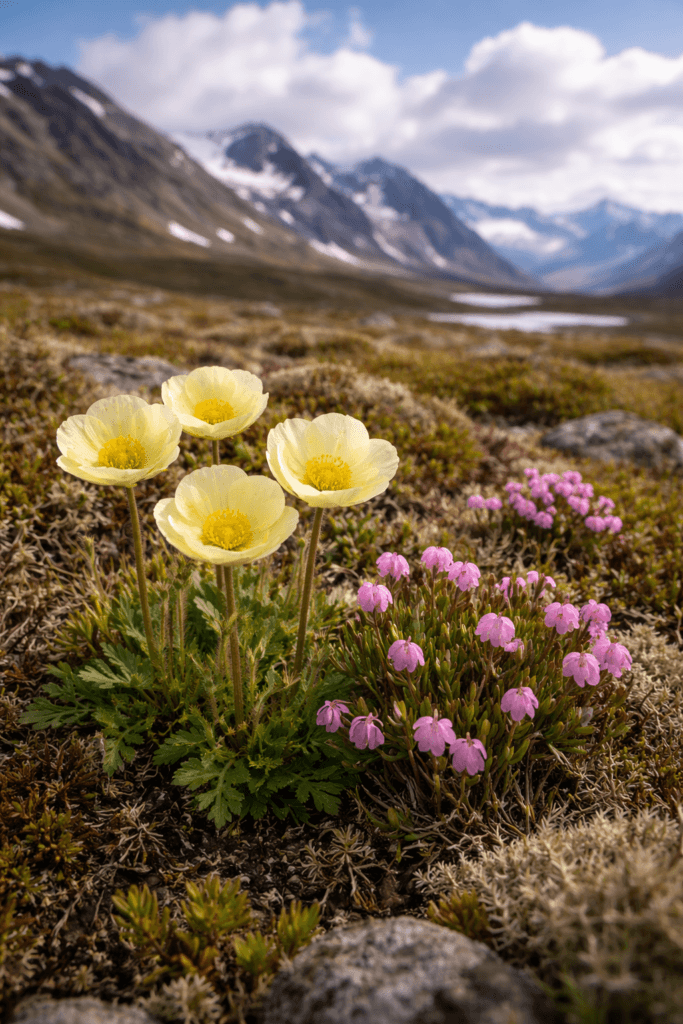
Tundra Flowers
Tundra flowers grow in northern Alaska and other areas with permafrost and shallow soils. These plants are highly adapted to cold temperatures and very short growing seasons.
Examples include Arctic Poppy, one of the most recognizable tundra flowers, and Bog Rosemary, which grows in moist tundra and wetland environments.
Alaska’s flower blooms are closely tied to seasonal timing. While exact bloom periods vary by region and weather, most flowers appear between late spring and mid-summer. In some areas, flowering may continue into early fall if conditions remain favorable.
Flowers play an important role in Alaska’s ecosystems. They support insects, birds, and other wildlife, contribute to seed production, and help protect fragile soils. For many people, flowers also act as seasonal markers, signaling the arrival of summer and the brief window of growth before winter returns.
Beyond ecology, flowers hold cultural importance in Alaska. Many species are tied to traditional knowledge, subsistence practices, and local traditions. Others are valued simply for their presence, adding color and contrast to landscapes often associated with rock, ice, and snow.
Alaska is home to hundreds of flowering plant species. Some are widespread and easy to recognize, while others are limited to specific regions or habitats.
The following flowers serve as starting points for learning more about Alaska’s plant life. Each can be explored in greater detail on its own dedicated page.
Explore some of the flowers found in Alaska Below:
Fireweed (Chamerion angustifolium) – Meadow / Disturbance Flower
— Tall pink flower that dominates open areas and burned ground; one of Alaska’s most recognizable summer blooms.
Forget-Me-Not (Myosotis alpestris) – Alpine / Tundra Flower
— Small blue flower and Alaska’s state flower; commonly found in alpine and open meadow environments.
Arctic Lupine (Lupinus arcticus) – Meadow / Tundra Flower
— Purple-blue flower growing in open fields and along roadsides; known for nitrogen-fixing properties in soil.
Arctic Poppy (Papaver radicatum) – Tundra Flower
— Bright yellow flower adapted to cold, windy environments; often found in Arctic and alpine regions.
Mountain Avens (Dryas octopetala) – Alpine / Tundra Flower
— Low-growing white flower that thrives in rocky alpine terrain and harsh conditions.
Shooting Star (Dodecatheon pulchellum) – Meadow / Woodland Flower
— Distinctive flower with swept-back petals; commonly found in moist meadows and open forests.
Moss Campion (Silene acaulis) – Alpine Cushion Plant
— Dense, pink-flowering cushion plant growing in harsh alpine environments; extremely cold-hardy.
Twinflower (Linnaea borealis) – Forest Floor Flower
— Delicate paired pink flowers growing low along mossy forest ground in shaded areas.
Wild Geranium (Geranium erianthum) – Meadow / Forest Edge Flower
— Purple flower found in open woods and meadows across Interior and Southcentral Alaska.
Arctic Cotton (Eriophorum angustifolium) – Wetland Flower
— White, cotton-like blooms found in bogs and tundra, often covering large wetland areas.
Purple Saxifrage (Saxifraga oppositifolia) – Alpine / Arctic Flower
— One of the earliest blooming flowers, growing low to the ground in rocky environments.
Alaska Violet (Viola langsdorffii) – Forest / Meadow Flower
— Small purple flower found in moist forests and meadows, blooming early in the season.
Northern Jacob’s Ladder (Polemonium boreale) – Alpine / Tundra Flower
— Blue to purple clustered flowers with ladder-like leaves, found in cooler northern regions.
Bluebell (Mertensia paniculata) – Woodland / Riparian Flower
— Drooping blue bell-shaped flowers commonly found near streams and moist forest areas.
Dwarf Dogwood (Cornus canadensis) – Forest Floor Flower
— White petal-like bracts surrounding a central cluster, growing low in mossy forest floors.
Yellow Marsh Marigold (Caltha palustris) – Wetland Flower
— Bright yellow flower found in wetlands and along streams, often one of the first to bloom in spring.
Alaska Wild Rose (Rosa acicularis) – Shrub / Flowering Plant
— Pale pink to deep pink rose found in open woods, riverbanks, and disturbed areas; produces fragrant blooms and bright red rose hips later in the season.
Alpine Azalea (Kalmia procumbens) – Alpine / Tundra Flower
— Low-growing pink flower found in alpine and tundra environments, forming small mats across rocky ground and harsh, high-elevation areas.
Lapland Rosebay (Rhododendron lapponicum) – Alpine / Tundra Flower
— Small purple-pink flower growing in tundra and alpine environments, often forming low mats across rocky, exposed ground.
Alaska Spirea (Spiraea beauverdiana) – Shrub / Flowering Plant
— Small flowering shrub with clusters of white to pale pink blooms, commonly found in tundra, alpine slopes, and open northern landscapes.