
Musk Ox in Alaska
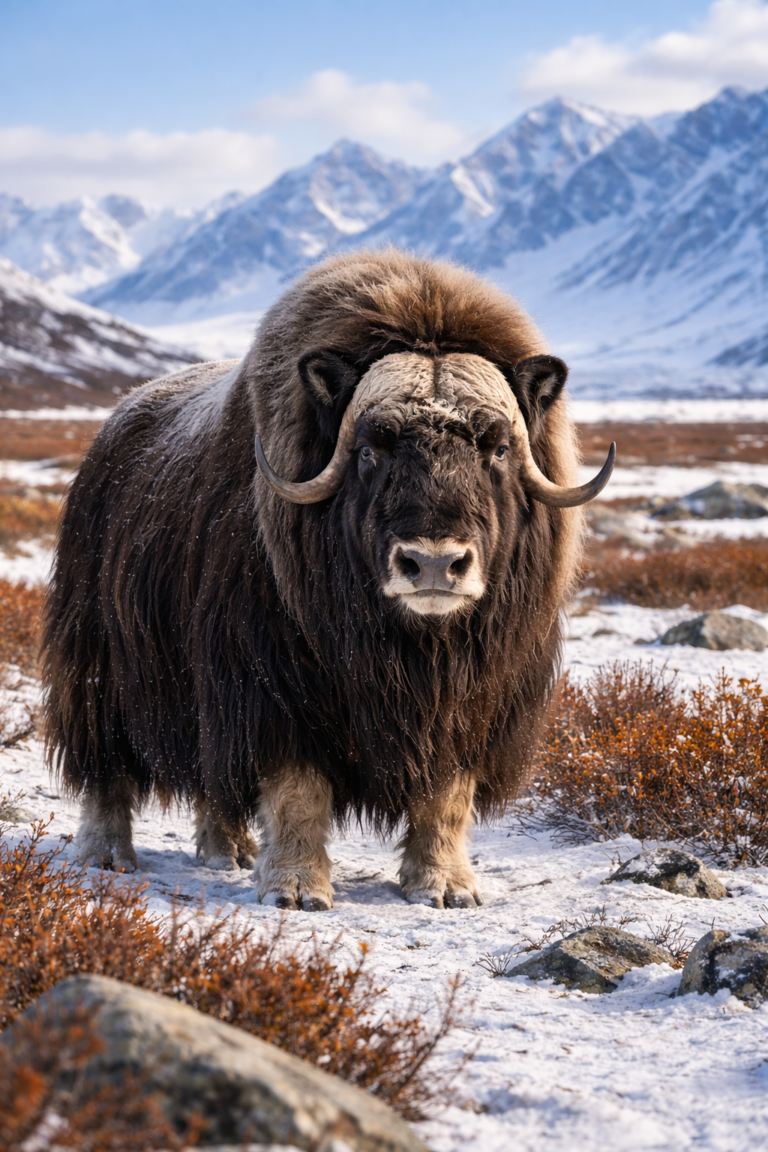
Musk ox don’t look modern. When you see them standing against the tundra — dark, shaggy silhouettes in wind that would knock you sideways — they feel prehistoric. They survived the last Ice Age, and in northern Alaska, they still move the way they always have: slowly, deliberately, in tight defensive groups. They are built for cold, not speed.
Identification
Musk ox are large Arctic mammals with thick, layered coats and curved horns.
-
Color: Dark brown to black
-
Size: 600–900 pounds
-
Horns: Both males and females have curved horns that sweep downward and up
-
Coat: Long outer hair (guard hair) with a dense insulating underlayer called qiviut
Their fur hangs nearly to the ground, protecting them from wind and blowing snow.
From a distance, a group of musk ox may look like a cluster of dark boulders against pale tundra.
Where You’ll See Them in Alaska
Musk ox are found primarily in:
-
Northern Alaska
-
Arctic coastal plain
-
Areas near Utqiaġvik (Barrow)
-
Portions of western tundra
They prefer open, treeless tundra and low rolling terrain.
Most sightings occur far north, often during Arctic travel or guided northern tours.
Seasonal Patterns
-
Winter: Group tightly together for warmth and protection
-
Spring: Calves born on tundra flats
-
Summer: Feeding on grasses, sedges, and tundra vegetation
-
Fall: Rutting season, with males clashing horns
When threatened, musk ox form a defensive circle with calves protected in the center — a strategy effective against wolves but less useful against modern predators. Musk ox were once extirpated from parts of Alaska but were reintroduced in the 20th century. Today, populations are carefully managed in northern regions. Qiviut — the soft underwool shed in spring — is one of the warmest natural fibers in the world and has long been used by Arctic communities for clothing.
If observing musk ox in Arctic conditions, distance is critical. They are powerful animals capable of sudden charges if they feel threatened. Wind exposure on open tundra can be severe, so insulated layers and windproof outerwear are essential even during summer months.
Musk ox don’t rush across the tundra. They endure it.