
How to Photograph the Northern Lights in Alaska
How to Photograph the Northern Lights in Alaska
Seeing the northern lights is one of the experiences that brings many people to Alaska. Watching green, purple, and red ribbons move across the sky is impressive on its own, but capturing that moment with a camera allows you to bring the memory home with you.
The good news is that northern lights photography is not as complicated as it first appears. You do not need the most expensive camera on the market, but you do need the right settings, a stable tripod, and a little patience. This guide covers the basics of photographing the aurora in Alaska and avoiding some of the most common mistakes.
What Causes the Northern Lights?
The northern lights, also known as the aurora borealis, occur when charged particles from the sun interact with Earth's atmosphere. These interactions create the colorful displays that can appear across Alaska's night sky.
Some nights produce faint glows on the horizon, while others create bright displays that stretch across the entire sky. Every aurora event is different, which is part of what makes them so fascinating to photograph.
You do not need to understand the science in detail to photograph them, but it helps to know that activity levels can change quickly throughout the night.
When Is the Best Time to Photograph the Northern Lights?
The northern lights are generally visible in Alaska from late August through April when the nights are dark enough to see them. Summer brings plenty of daylight, which makes aurora viewing difficult or impossible even when activity is occurring.
Peak viewing often occurs between 10:00 PM and 2:00 AM, although displays can happen outside those hours. Clear skies are just as important as aurora activity because clouds can completely block the view.
The best strategy is to monitor both aurora forecasts and weather forecasts before heading out.
Where to Photograph the Northern Lights in Alaska
One of the biggest advantages Alaska offers is access to dark skies. Moving away from city lights can dramatically improve both visibility and photo quality. Even a short drive outside town can make a noticeable difference.
Interior Alaska is particularly popular for northern lights photography because of its long winter nights and frequent clear skies. Areas around Fairbanks have become some of the most well-known aurora viewing destinations in the world.
Look for locations with open views of the sky, interesting foreground subjects, and minimal artificial light.
- Lakes and ponds
- Mountain viewpoints
- Frozen rivers
- Open valleys
- Scenic pullouts
- Remote roads away from city lights
Camera Settings for Northern Lights Photography
The goal is to gather as much light as possible while keeping stars and aurora details reasonably sharp. Most northern lights photography relies on manual settings because automatic modes often struggle in dark conditions.
A good starting point is to use a wide aperture, moderate ISO, and exposure time long enough to collect light without creating excessive blur. Every aurora display is different, so adjustments may be necessary throughout the night.
These settings provide a useful starting point for most situations.
- Manual mode
- Aperture: f/1.4 to f/2.8 if available
- ISO: 800–3200
- Shutter speed: 5–20 seconds
- Manual focus
- RAW image format
Choosing the Right Camera
You do not need a professional camera body to photograph the northern lights, but low-light performance certainly helps. Modern mirrorless and DSLR cameras generally perform very well when paired with the right lens.
Larger sensors often provide cleaner images at higher ISO settings. However, many travelers have captured excellent aurora photos using mid-range equipment and a little patience.
Understanding your camera before the trip is often more important than buying new equipment at the last minute.
Choosing the Right Lens
Wide-angle lenses are typically the most popular choice for northern lights photography. They allow you to capture a larger portion of the sky while including mountains, trees, cabins, lakes, or other foreground elements.
A lens with a wide maximum aperture can gather more light, which helps reduce noise and shorten exposure times. Fast lenses are especially helpful when the aurora is moving quickly.
If you only bring one lens specifically for aurora photography, a fast wide-angle lens is usually the best choice.
- Wide-angle focal lengths
- Fast apertures
- Good low-light performance
- Weather-resistant construction when possible
Why a Tripod Matters
A tripod is one of the most important pieces of northern lights photography equipment. Long exposures make handheld photography almost impossible in most situations.
Your tripod does not need to be massive, but it should be stable enough to handle wind and cold conditions. Lightweight travel tripods work well as long as they remain steady during exposure.
Even the best camera and lens combination will struggle without a stable platform.
Focusing in the Dark
Autofocus systems often struggle at night, especially when there are few bright objects available. Learning how to focus manually before your trip can save a lot of frustration.
Many photographers focus on a bright star, distant light, or other far-away object and then switch to manual focus. This prevents the camera from hunting for focus every time you take a photo.
Check focus regularly throughout the evening to make sure nothing has shifted.
Battery Management During Aurora Photography
Cold weather is one of the biggest challenges during northern lights photography. Batteries often lose power much faster in winter conditions than they do indoors.
Carry multiple batteries and keep spares inside a warm pocket whenever possible. A battery that appears dead may regain some charge after warming up.
Planning for battery loss ahead of time is far easier than ending your night early because everything ran out of power.
- Bring multiple batteries
- Keep spares warm
- Carry a power bank
- Minimize unnecessary screen use
- Charge everything before heading out
Common Northern Lights Photography Mistakes
Many beginners make the mistake of using automatic settings and expecting the camera to handle everything. Unfortunately, night photography often requires more manual control than daytime photography.
Another common mistake is leaving before the show starts. Aurora activity can increase dramatically within minutes, and patience often rewards photographers who stay out longer.
Finally, do not forget to enjoy the experience. It is easy to become so focused on camera settings that you forget to simply watch the sky.
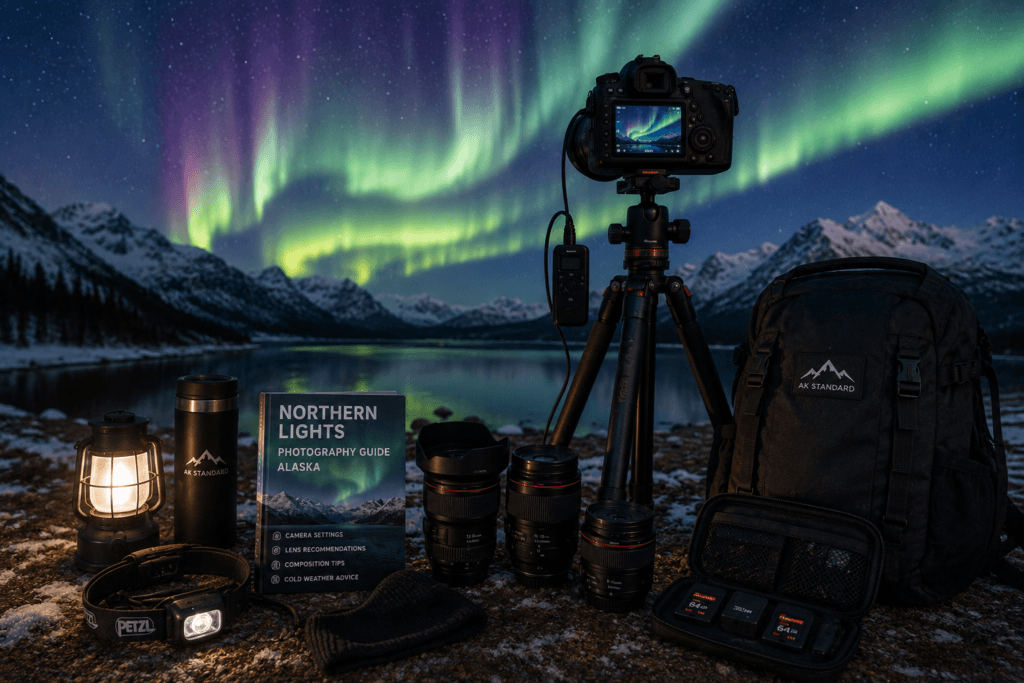
What to Pack for Northern Lights Photography
Photographing the aurora usually means standing outside for extended periods. Comfort becomes just as important as camera gear if you want to stay out long enough to capture great images.
Bring warm clothing, extra batteries, and the basic equipment needed to operate comfortably in cold temperatures.
- Camera
- Wide-angle lens
- Tripod
- Extra batteries
- Battery charger
- Headlamp
- Power bank
- Warm gloves
- Warm boots
- Extra layers
Related Alaska Photography & Tech Guides
These guides can help you build the rest of your Alaska photography setup and improve your overall results in the field.
- Alaska Photography Packing List
- Best Cameras for Alaska Travel
- Wildlife Photography Gear for Alaska
- Best Tripods for Wildlife Photography in Alaska
- Battery Management for Alaska Adventures
- Alaska Adventure Tech Packing List
Final Thoughts
Photographing the northern lights in Alaska is one of the most rewarding photography experiences available anywhere in the world. The combination of dark skies, beautiful landscapes, and frequent aurora activity creates incredible opportunities for photographers of all skill levels.
You do not need perfect equipment to get started. A camera, a tripod, a little preparation, and some patience will take you much farther than most people realize. Learn your settings before the trip, dress for the conditions, and enjoy the experience when the sky finally comes alive above you.