
Western Hemlock in Alaska
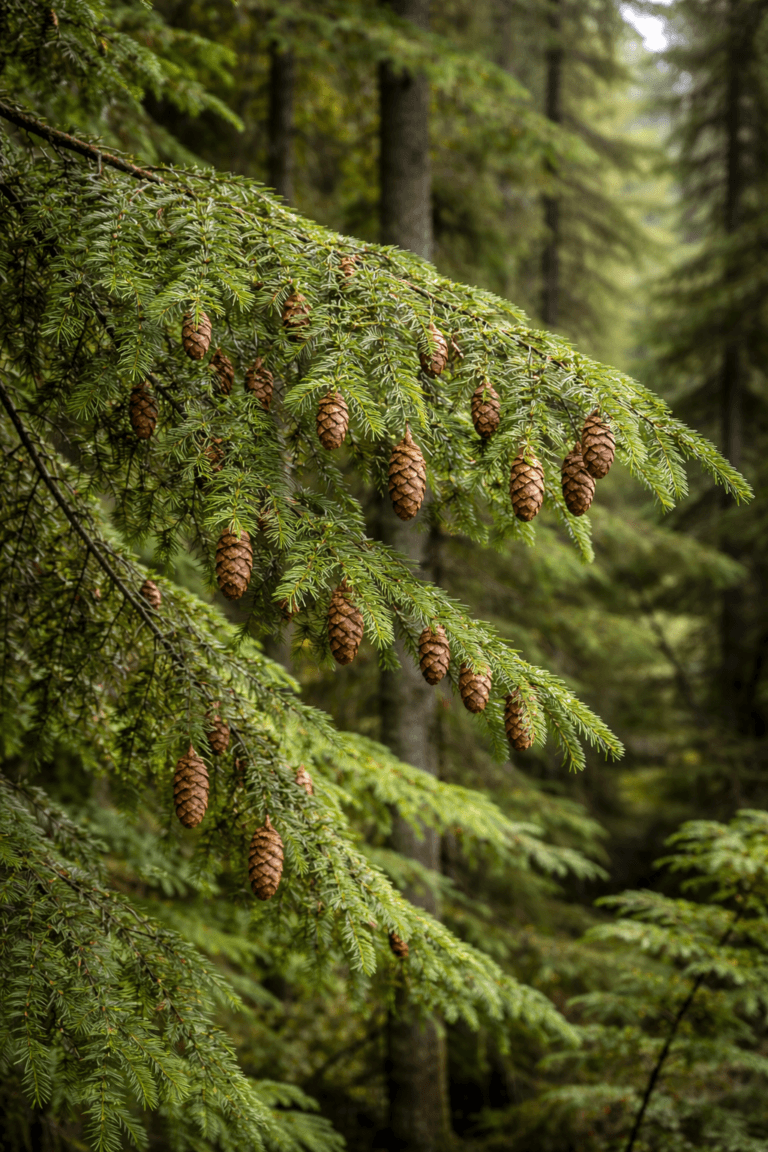
Western Hemlock in Alaska
If you’ve walked through Southeast Alaska and felt like the forest swallowed the light, you were probably standing under western hemlock.
Tall, shadowy, and layered thick, this tree defines the coastal rainforest. It doesn’t grow straight and rigid like spruce. It leans. It droops. Its top leader often bends slightly to one side.
Western hemlock gives Southeast Alaska its deep, moss-covered, old-growth feel.
Where It Grows
Western hemlock prefers:
• Southeast Alaska
• Coastal rainforest
• Moist, cool climates
• Sea level up to mid-elevation slopes
• Thick mossy forest floors
It thrives in constant moisture. If you’re in a place where the ground is soft with moss, the air smells damp, and everything feels green even on a gray day, you’re in hemlock country.
It often grows alongside Sitka spruce and yellow cedar.
When to Notice It
Year-round.
Like spruce, it’s evergreen. But it stands out most in the coastal rainforest where it forms dense canopy cover.
Young trees tolerate deep shade. That’s why you’ll see layers of hemlock saplings growing beneath larger trees.
How to Identify It
Key traits:
• Soft, flat needles
• Needles are short and uneven in length
• Two white stripes underneath each needle
• Branch tips droop
• Top leader often bends slightly
• Small cones (about ¾–1 inch long) that hang downward
The needles are softer than spruce. If you gently pinch them, they won’t feel sharp or square.
That drooping top is one of the easiest field clues. Spruce tends to point straight up. Hemlock often looks slightly relaxed at the top.
Is It Useful?
Yes, but differently than spruce.
Western hemlock wood is lighter and not as strong as Sitka spruce, but it has been used for:
• Construction lumber
• Pulp and paper
• Interior framing
• Traditional bark and wood uses
It’s not typically a preferred firewood — it burns faster and less hot than dense spruce.
If you’re exploring Southeast forests, waterproof boots are non-negotiable. The ground stays wet most of the year, and dry feet matter more than most people realize.
Why It Matters in Alaska
Western hemlock is one of the dominant trees of Southeast Alaska.
It creates the canopy. It shapes the forest floor. It gives coastal Alaska that dense, layered, almost prehistoric atmosphere.
Without it, Southeast wouldn’t feel the same.
If you’re learning Alaska trees, recognizing western hemlock is the key to understanding coastal rainforest structure.
Learn about more coastal and Interior species in Trees of Alaska.