
Alaska During World War II
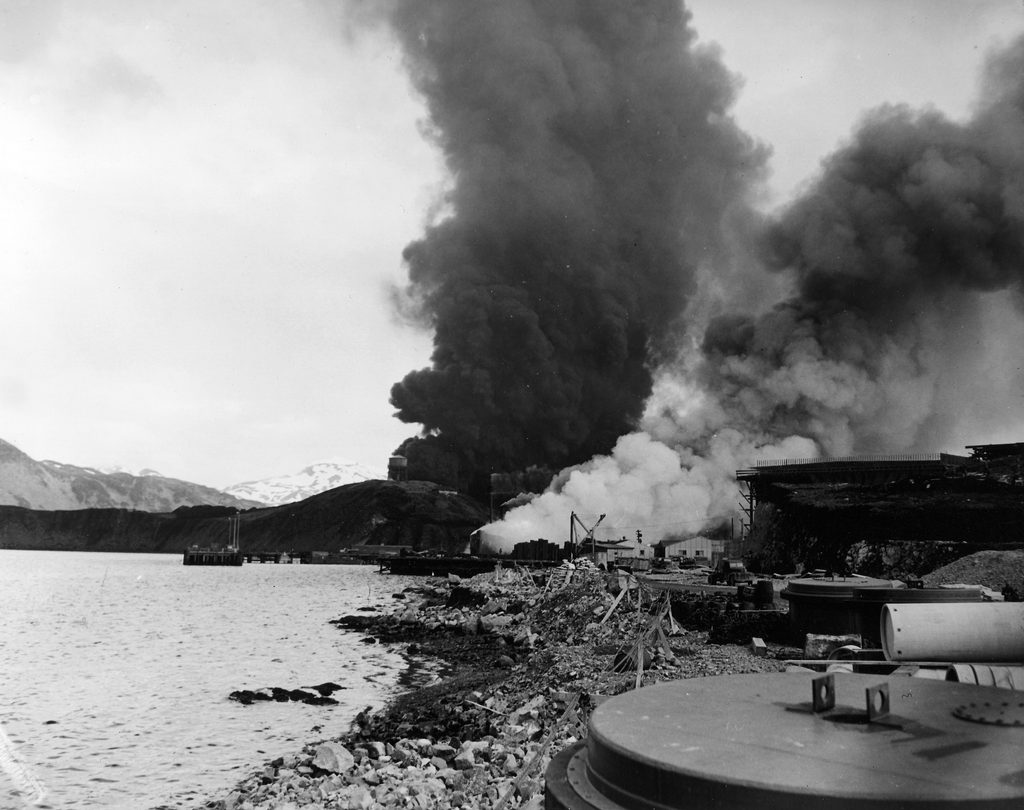
Dutch Harbor, Alaska, during the Japanese attack on June 4, 1942. Photograph by Capt. Lewis R. Devoe, USNR. Courtesy of the U.S. Navy National Museum of Naval Aviation. Public domain.
Alaska During World War II
World War II transformed Alaska from a remote American territory into one of the most strategically important regions in the North Pacific. Between 1941 and 1945, Alaska became a battleground, a center of military construction, and a vital transportation corridor connecting the United States with its wartime allies.
Japanese forces attacked Dutch Harbor and occupied two islands in the Aleutian chain. American and Canadian troops fought to regain control of the territory, while thousands of military personnel and civilian workers constructed airfields, roads, naval facilities, and defensive installations throughout Alaska.
But Alaska's wartime history extends far beyond military operations. Alaska Native volunteers helped defend remote communities, families were displaced from their ancestral homes, and towns experienced enormous economic and social changes. The effects of the war continued long after Japan surrendered in 1945.
Today, abandoned military installations, historic battlefields, museums, and surviving wartime infrastructure reveal how profoundly World War II changed Alaska.
Why Alaska Was Strategically Important
Alaska's geography made it a critical location for American military planners. Positioned between North America and Asia, the territory provided access to the northern Pacific and offered potential locations for airfields, naval installations, and coastal defenses.
The Aleutian Islands extend more than a thousand miles southwest from mainland Alaska toward the northern Pacific. Their position made them important for monitoring maritime activity and projecting military power across the region.
Before the war, Alaska had relatively limited military infrastructure. Transportation between communities depended heavily on ships and aircraft, and most settlements lacked connections to a comprehensive road network.
As tensions increased in the Pacific during the late 1930s and early 1940s, the United States began strengthening Alaska's defenses. Military facilities expanded around Anchorage, Kodiak, Sitka, and Dutch Harbor, while additional aviation installations were developed to support operations throughout the territory.
Following Japan's attack on Pearl Harbor on December 7, 1941, the defense of Alaska became an increasingly urgent military priority.
The Japanese Attack on Dutch Harbor
On June 3 and 4, 1942, Japanese aircraft launched attacks against American military installations at Dutch Harbor in the Aleutian Islands.
The attacks damaged buildings, fuel storage facilities, vessels, and other military infrastructure. American personnel were killed and wounded, and the raids demonstrated that Alaska was vulnerable to direct attack.
The bombing occurred during the same period as the Battle of Midway in the central Pacific. Japanese military operations in the Aleutians were part of a broader strategy involving the northern Pacific, although historians have debated the precise strategic relationship between the two operations.
For residents and military personnel in Alaska, the attacks made the war immediate and personal. The conflict was no longer something taking place exclusively across distant oceans.
Japan Occupies Attu and Kiska
Within days of the Dutch Harbor attacks, Japanese forces occupied Attu and Kiska, two islands in the western Aleutians.
The occupation represented one of the few instances during World War II when Japanese forces occupied American-controlled territory.
Japanese troops established defensive positions and military facilities while American commanders began planning operations to regain control of the islands.
The occupation also raised concerns about additional attacks and the possibility of Japanese forces using the Aleutians to threaten shipping routes or military installations elsewhere in Alaska.
The Aleutian Islands Campaign
The Aleutian Islands Campaign became one of the most difficult military operations of World War II.
Soldiers, sailors, and pilots faced an environment characterized by dense fog, powerful winds, freezing temperatures, rough seas, and rugged volcanic terrain.
Weather frequently disrupted military operations. Aircraft encountered dangerous visibility conditions, ships struggled through heavy seas, and soldiers suffered from exposure and inadequate equipment.
In many situations, the environment was nearly as dangerous as enemy forces.
The Battle of Attu
On May 11, 1943, American forces landed on Attu to reclaim the island from Japanese occupation.
The fighting lasted nearly three weeks as American troops advanced through difficult terrain against determined Japanese resistance.
Cold temperatures, wet clothing, inadequate shelter, and challenging supply conditions contributed to casualties and illness among American troops.
Near the end of May, Japanese forces launched a final assault before organized resistance collapsed.
The Battle of Attu became one of the most significant ground battles fought on North American territory during World War II.
The Liberation of Kiska
Following the recapture of Attu, Allied commanders prepared to invade Kiska.
However, Japanese forces secretly evacuated the island in July 1943, taking advantage of fog and poor visibility.
When American and Canadian troops landed on August 15, 1943, they expected substantial resistance. Instead, they discovered that Japanese forces had already departed.
Despite the absence of enemy troops, the operation resulted in casualties caused by mines, accidents, and friendly fire.
The recapture of Kiska marked the end of Japanese occupation in the Aleutian Islands.
Military Bases and Defense Construction
World War II brought an extraordinary expansion of military infrastructure throughout Alaska.
Army, Navy, and aviation facilities were constructed or enlarged to protect the territory, support operations in the Aleutians, and establish transportation and supply networks.
Anchorage and Fort Richardson
Anchorage developed into a major military center during the war.
Fort Richardson and Elmendorf Field became important installations supporting ground defense, aviation operations, and military logistics.
The arrival of military personnel and civilian workers contributed to Anchorage's rapid growth and helped establish its long-term importance as a military and transportation center.
Kodiak Naval Facilities
Kodiak became an important naval installation supporting operations throughout the North Pacific.
Military construction expanded harbor facilities, airfields, coastal defenses, and support infrastructure.
The island's location provided strategic advantages for protecting maritime routes and supporting operations toward the Aleutian Islands.
Military Installations in the Aleutians
Additional military facilities were established throughout the Aleutian chain.
Adak became a particularly important forward operating location as American forces advanced westward.
Airfields, defensive positions, roads, docks, and supply facilities were constructed in remote locations where transportation and weather presented enormous challenges.
Some of these installations remained in military use after the war, while others were eventually abandoned.
The Alaska Highway During World War II
One of the most enduring wartime construction projects was the Alaska Highway.
Built in 1942, the highway established an overland route through western Canada into Alaska, strengthening transportation and military access to the territory.
Construction crews faced forests, mountains, rivers, muskeg, extreme temperatures, and vast areas without established roads.
American Army engineers and civilian contractors worked rapidly to establish the initial military route.
African American engineering regiments played a significant role in the project despite serving in a segregated United States Army. Their contributions have become an increasingly recognized part of the highway's history.
The original wartime highway was rough and required substantial improvements, but it created a transportation corridor that would eventually become essential for travel and commerce between Alaska and the rest of North America.
The Alaska Highway remains one of the most visible physical legacies of World War II in the territory.
The Northwest Staging Route and Lend-Lease
Alaska also served as an important transportation link in the Allied effort to supply the Soviet Union with military aircraft.
Under the Lend-Lease program, the United States supplied aircraft and other military equipment to Allied nations.
The Northwest Staging Route connected airfields across western Canada and Alaska, allowing American aircraft to reach Fairbanks.
At Ladd Field, Soviet personnel received aircraft before flying them onward through Siberia.
The Alaska-Siberia route required extensive cooperation between American and Soviet personnel, specialized aircraft maintenance, and careful planning for northern flying conditions.
Thousands of aircraft passed through this system during the war.
The operation demonstrated Alaska's strategic importance beyond its immediate military defense. The territory became part of a larger international supply network supporting the Allied war effort.
The Alaska Territorial Guard
Alaska Native residents played an important role in defending the territory during World War II.
The Alaska Territorial Guard was organized in 1942 to help protect remote communities and monitor vulnerable coastal regions.
Its volunteers included Alaska Native men from communities across western, northern, and interior Alaska.
Many possessed extensive knowledge of local geography, weather, coastal conditions, and wilderness travel.
Guard members conducted patrols, observed suspicious activity, supported local defense preparations, and helped maintain security in regions far from major military installations.
Many volunteers continued supporting their families and communities while performing military duties.
The service of Alaska Territorial Guard members represents an important chapter in both Alaska Native history and American military history.
The Forced Evacuation of Unangax Communities
One of the most tragic consequences of World War II in Alaska was the forced evacuation of Unangax people from their homes in the Aleutian and Pribilof Islands.
Following the Japanese attacks in 1942, the United States government removed hundreds of Indigenous residents from their communities and relocated them to camps in Southeast Alaska.
Many evacuees were housed in abandoned canneries and other facilities that were poorly suited for extended occupation.
Overcrowding, inadequate sanitation, insufficient medical care, and difficult living conditions contributed to serious illness and deaths.
Families were separated from their homes, traditional food sources, cultural landscapes, and livelihoods.
When survivors eventually returned, many found their communities damaged and personal belongings missing or destroyed.
Residents of Attu experienced a different tragedy. Japanese forces transported the village's Indigenous residents to Japan, where some died before the end of the war.
The forced evacuation and internment of Unangax communities remain among the most painful chapters of Alaska's wartime history.
These experiences demonstrate that the consequences of military conflict extended far beyond the battlefield.
Life in Alaska During Wartime
World War II changed daily life across Alaska.
Communities experienced increased military activity, rapid population growth, new employment opportunities, and changes in transportation and communication.
Construction projects created jobs for civilian workers, while military installations required supplies, equipment, food, housing, and transportation services.
Women contributed through civilian employment, military-related work, community organizations, and household responsibilities.
Remote communities faced different challenges from growing military centers such as Anchorage and Fairbanks.
Some residents benefited from new infrastructure and employment opportunities, while others experienced displacement, shortages, restrictions, or disruptions to traditional ways of life.
The wartime period marked a major turning point in Alaska's economic and social development.
How World War II Changed Alaska
By the time World War II ended in 1945, Alaska had undergone dramatic changes.
Military construction expanded transportation networks, airfields, ports, roads, communication systems, and defensive installations.
The arrival of military personnel and civilian workers contributed to population growth and helped transform communities throughout the territory.
Anchorage and Fairbanks emerged from the war with expanded infrastructure and greater importance to transportation, commerce, and national defense.
Alaska's strategic position also became increasingly significant during the Cold War.
Military planners recognized the territory's importance for Arctic aviation, early warning systems, and defense against potential threats approaching North America from the north.
Although Alaska would not become a state until 1959, World War II helped accelerate economic, demographic, and infrastructure changes that influenced its future development.
Historic World War II Sites in Alaska
Evidence of Alaska's wartime history remains visible across the state.
Historic military installations, abandoned airfields, coastal defenses, battlefields, museums, and memorials preserve important parts of this history.
The Aleutian Islands contain some of the most significant wartime sites, including locations associated with the Battle of Attu, the occupation of Kiska, and American military operations on Adak.
Kodiak, Anchorage, Fairbanks, and other communities also retain historic connections to military construction and aviation operations.
Many locations are remote, difficult to access, or subject to land ownership, preservation, and safety restrictions.
Visitors interested in Alaska's military history should research access requirements before attempting to visit historic sites.
The Lasting Legacy of World War II in Alaska
World War II permanently changed Alaska's relationship with the rest of the United States.
The territory became an important military frontier, gained new transportation infrastructure, and experienced substantial economic and demographic transformation.
Its wartime history also includes difficult experiences involving displacement, loss, discrimination, and the hardships endured by military personnel and civilians.
Today, Alaska's World War II story is preserved through historic sites, archival photographs, museums, oral histories, and the work of historians and preservation organizations.
Understanding this history reveals how a remote American territory became a central part of national defense and how the consequences of war helped shape modern Alaska.
Historical Sources & References
The following historical resources provide additional information about Alaska's role in World War II, the Aleutian Islands Campaign, military construction, and wartime experiences.
Historical Photograph Credit
Featured photograph: Dutch Harbor, Alaska, during the Japanese attack on June 4, 1942. Photograph by Capt. Lewis R. Devoe, USNR. Courtesy of the U.S. Navy National Museum of Naval Aviation. Public domain.
View the original historical photograph and source information